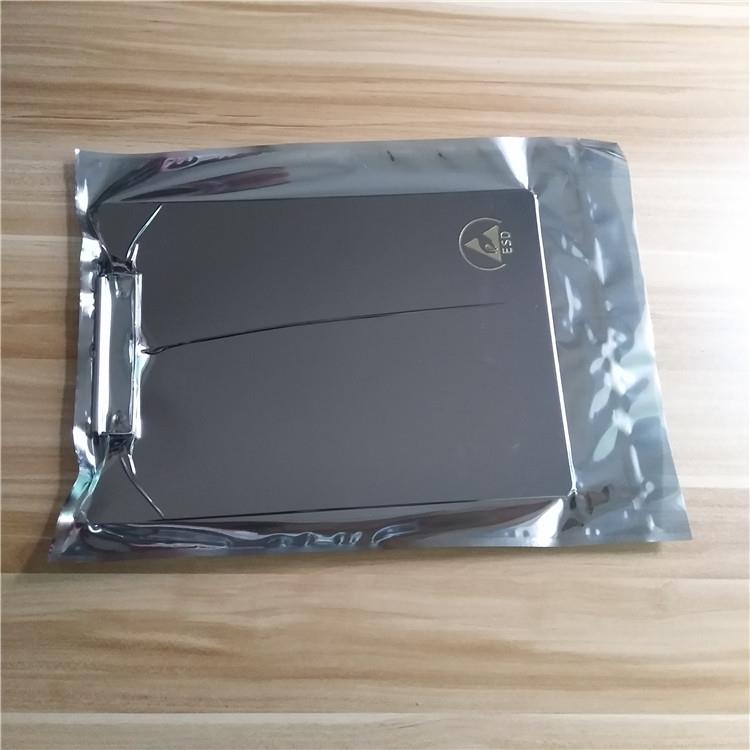
How to judge whether the anti-static shielding bag is invalid?


Anti-static shielding bags are more commonly used for the packaging of static-sensitive circuit boards, precision parts and electronic components. It protects static-sensitive components from potential electrostatic hazards to the greatest extent, and their unique Faraday cage construction creates a “sensing hood” effect and provides shielding and anti-static effects on the contents of the bag.
But everything has special characteristics. For example, the anti-static shielding bag may fail. Do you know how to judge whether the anti-static shielding bag has failed?
In the MIL-B-81705C standard file, any of the following conditions can be considered invalid:
1. The stratification phenomenon as detailed in Section 4.8.4.1 appears.
2. The static discharge decay rate is greater than 2 seconds.
3. Attenuating electromagnetic interference is less than 10dB.
4. The bag body has small holes and the diameter is more than 2mm.
5. It is not possible to shield electrostatic discharge events below 30kV.
6. The surface resistance per square area inside and outside is greater than 10^12, and the internal resistance per level is less than 10^5.
In short, due to the Faraday effect, if the anti-static shielding bag has creases or small holes, it is better to throw it away and not to damage the components inside because of the cost of saving the bag.