


Characteristics of Anti-Static Vacuum Cleaners
An "anti-static vacuum cleaner" is not a single, standardized product, but rather a functional category. Different brands and models focus on different aspects of anti-static design-some prioritize ESD (electrostatic discharge) protection for cleanrooms, while others emphasize explosion-proofing for industrial environments.
The design logic behind an anti-static vacuum cleaner is to provide a continuous, low-resistance path for static charges to travel from the suction nozzle to the ground. This means that anti-static measures must encompass the entire system-including the filter, hoses, canister, and exhaust-rather than relying on superficial additions like an "anti-static filter" or an "explosion-proof motor." If anti-static protection is only applied to specific parts, static charges may still accumulate in untreated areas, leaving the risks unaddressed.
Anti-static performance is not a vague concept; it is defined by specific resistance values.
Surface Resistance
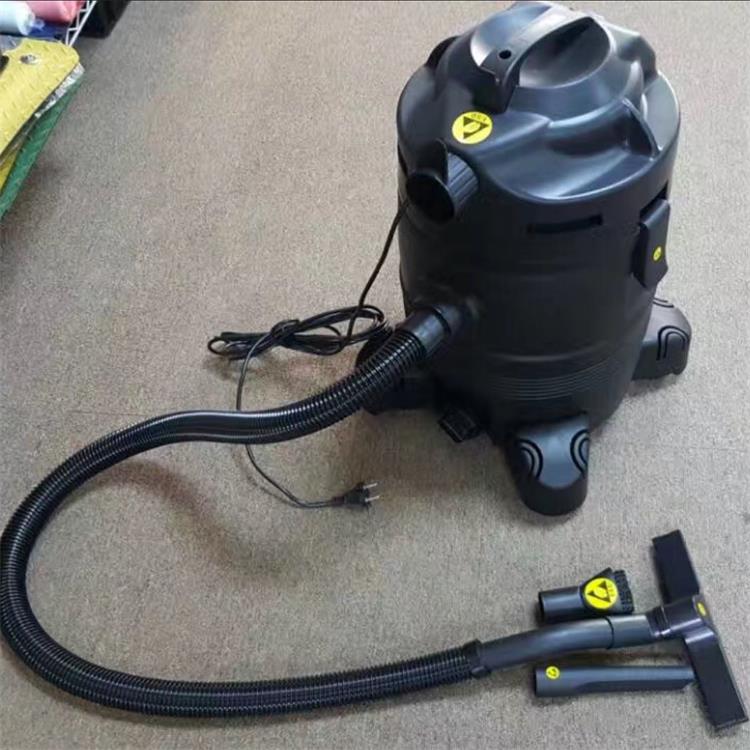
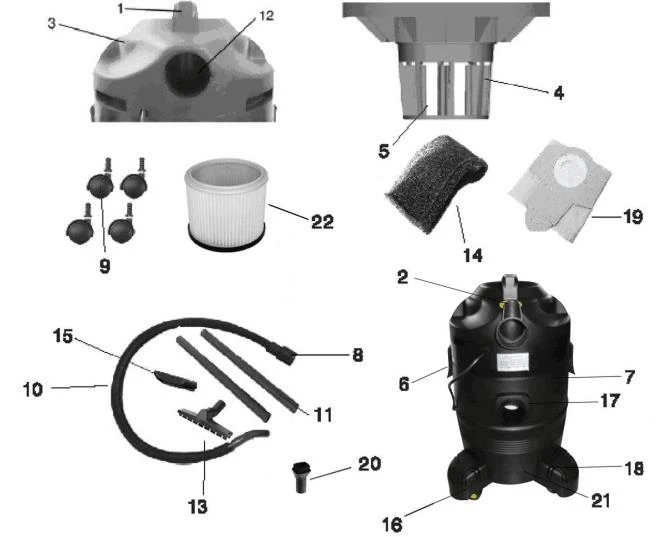
Materials used for components that come into contact with the environment-such as the equipment housing, hoses, and suction nozzles-must possess either static-dissipative or conductive properties. A common compliant range is 10⁵–10⁹ Ω (with some standards allowing for 10⁴–10¹¹ Ω). This range enables the gradual dissipation of static charges without creating a path for dangerous, high-current surges. High-specification products may achieve point-to-point resistance levels of 10⁴–10⁵ Ω, or even maintain a resistance of less than 10 Ω between any two points on the entire unit.
Grounding Resistance
Using conductive materials alone is insufficient; static charges must be reliably channeled into the ground. The grounding system of an anti-static vacuum cleaner typically requires a resistance of ≤1 Ω (which may be relaxed to ≤4 Ω in industrial explosion-proof applications). This ensures that static electricity is released rapidly and completely, rather than merely "leaking" slowly across the equipment.
🧱 Material and Structural Design: Minimizing Charge Generation at the Source and Ensuring Effective Dissipation
Conductive/Static-Dissipative Materials: Components such as housings, hoses, nozzles, and brushes are typically constructed from conductive plastics-infused with carbon fibers, carbon powder, or metal powders-or from metals like stainless steel. Some products utilize permanent carbon-fiber-based materials, which provide anti-static performance independent of ambient humidity, ensuring stable operation even during dry winter months.
Continuous Grounding Path: A continuous conductive path is maintained from the tip of the nozzle to the motor housing, ensuring that any generated electrical charge is dissipated immediately rather than accumulating at any point in the system. Grounding can be achieved via the ground pin in the power cord, or through the use of conductive grounding chains or grounding clips.
Anti-Static Components: Specialized elements-such as anti-static casters (which prevent the insulating effect common with standard rubber wheels) and conductive-fiber filter elements-are essential for ensuring a fully continuous conductive path.
Filtration and Cleanliness: Addressing Both Static Control and Contamination
In sectors such as electronics, semiconductor manufacturing, and precision optics, static control and cleanliness are inextricably linked. Static electricity attracts airborne particles, and these particles themselves may carry an electrical charge. Consequently, anti-static vacuum cleaners are typically equipped with HEPA (H13/H14) or even ULPA-grade filtration, capable of capturing 0.3 μm particles-with some models achieving an efficiency of 99.995% for particles of this size-making them suitable for use in ISO Class 4–8 cleanroom environments. Certain models also feature EMI/RFI shielding to prevent the motor from causing electromagnetic interference with sensitive equipment.