


Dissipation mechanism of anti-static work clothes
Anti-static work clothes refer to work clothes sewn with anti-static fabric as the fabric to prevent the accumulation of static electricity on the clothing. Anti-static fabric is a fabric formed by mixing conductive fibers or anti-static synthetic fibers or both at roughly equal intervals or evenly during weaving. Conductive fiber refers to the general term for fibers made of metal or organic conductive materials or sub-conductive materials in whole or in part, and its volume resistivity ρv~ is between 104~109Ω·cm. According to the distribution of conductive components in the fiber, the conductive fibers can be divided into three types: uniform conductive components, conductive component covering types, and conductive component composite types. At present, most anti-static fabrics are made of conductive fibers, especially the conductive component composite type, that is, composite fibers are used most often.


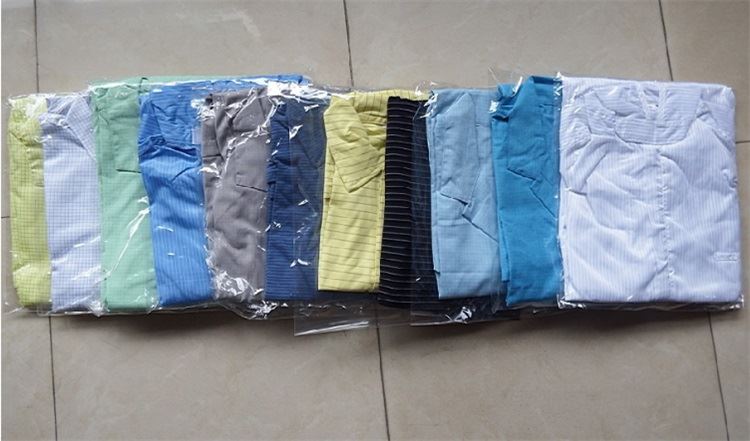
The anti-static work clothes made by adding conductive fibers to chemical fiber fabrics are based on two mechanisms: leakage and neutralization of charges. When grounded, the static electricity on the fabric is neutralized by the corona discharge of the conductive fiber, and can also be discharged to the ground through the conductive fiber; when it is not grounded, it is dissipated by the weak corona discharge of the conductive fiber.
Practice has shown that anti-static work clothes can effectively suppress static electricity in clothing and eliminate or reduce the hazards of electrostatic discharge. The following table shows the comparison of the human body electrification when the operator wears different work clothes.