


Differences Between Ionizing Blowers and Ionizing Air Snakes
Both ionizing blowers and ionizing air snakes are commonly used in industrial settings for static elimination and dust removal. However, they differ significantly in terms of structure, airflow characteristics, and application scenarios:
1. Appearance and Structural Design
• Ionizing Blower: Typically features a fan-based or box-style design (available in desktop, horizontal, or overhead/suspended configurations). It contains an internal fan that propels air, creating a broad, fan-shaped stream of ionized air.
• Ionizing Air Snake: Designed with a flexible, snake-like hose (or an elongated tubular structure). It generally requires an external compressed air supply and features a nozzle at the end of a flexible hose that can be bent, shaped, and directed as needed.
2. Airflow and Operating Principle
• Ionizing Blower: Utilizes an integrated fan to generate a wide, natural airflow. It produces positive and negative ions via corona discharge to neutralize static electricity.

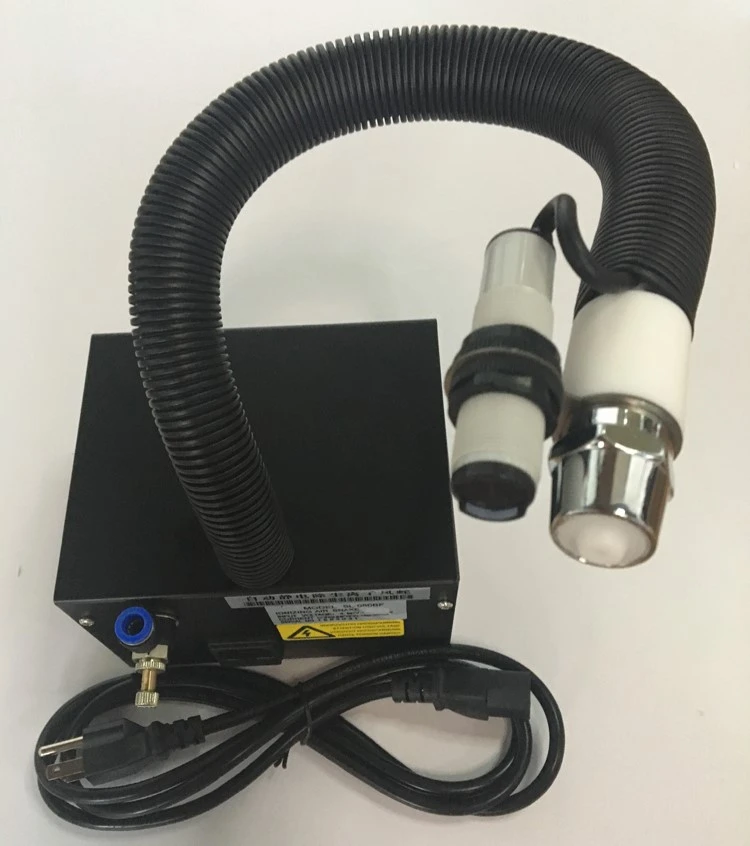
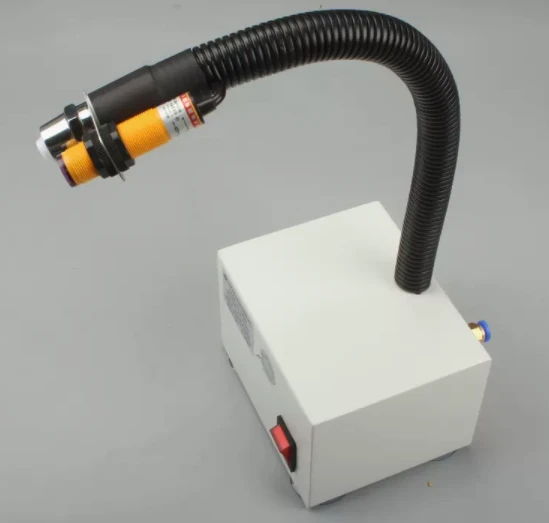
• Ionizing Air Snake: Relies on an external compressed air source to deliver a concentrated, high-pressure stream of ionized air through a slender, flexible tube. This produces a stronger, more forceful blast capable of dislodging fine dust particles.
3. Application Scenarios
• Ionizing Blower: Ideal for static protection and elimination across larger areas or specific workstations, such as those found on electronics assembly lines or in semiconductor manufacturing.
• Ionizing Air Snake: Suited for confined spaces, hard-to-reach areas, or tasks requiring powerful dust removal and targeted, rapid static neutralization on the surfaces of precision components (e.g., cleaning the interiors of precision machinery, molds, or specific high-precision parts).