


Method for laying dissipative table mat and floor mat
Lay the dissipative mat on the table, connect the button of the antistatic grounding line on the surface and connect the other end to the grounding conductor, to discharge the static electricity through the grounding wire.
1. The upper surface is to gather the static electricity around the table, with the resistance of 10e7 - 10e9 Ω Cm
2. The black bottom is a conductor ≤ 10e6 Ω Cm, to quickly discharge the gathered static electricity
3. The grounding wire is to connected with the dissipative mat and the other end to the ground, to smoothly discharge the static electricity through the wire.
1. Requirements on floor
A. The floor shall be the wet rubbing, ceramic or wooden floor;
B. It shall be flat, without obvious undulation, and with the roughness less than 2‰ ;
C. It shall be in enough strength, without sand streak or scaling.
D. The floor shall be dry.
2. Construction procedures and methods
A. Clean the floor with #120 gasoline or xylene (with cleaning machine);
B. Lay the copper bars or aluminum bars, when the copper bars are 0.02mm thick and 30mm wide, the length and number shall be subject to the actual requirements during laying, and lead one end of the copper bars to ground.
C. After laying the grounding grid, clean the dry floor, coat the conductive glue, and allow it to dry for 20`30 minutes until it is not sticky. Repeat the same procedures for the bottom of the antistatic floor mat (black), but coat the conductive glue once. Then bind the antistatic plastic on the floor, roll 5 times with heavy roller, to make it flat and smooth. Allow it to stay for 48 hours under normal temperature before use.
D. Construct under the ambient temperature not less than 25° C and the humidity not more than45%, and well ventilated.
E. Ensure the resistivity of conductive glue not more than 108Ω Cm, and the anti-stripping strength at Kg/2.5cm.
F. Coat the conductive glue or paste on the copper bar for conductivity in the gaps.
Applications:
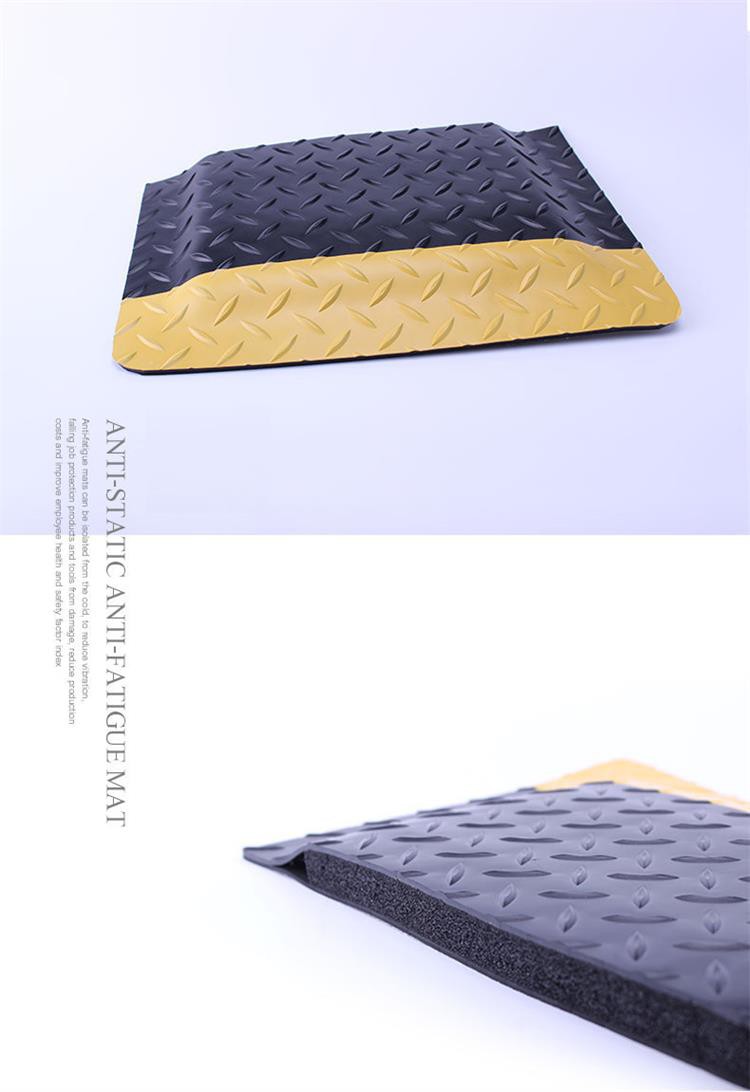
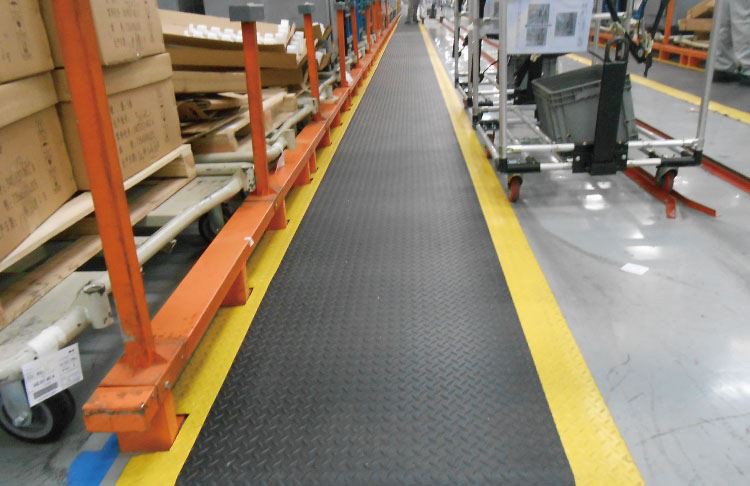
It is used for workstation surface and provide a cushiony ESD surface that is resistant to heat and most of the chemicals.
It is ideal for use in setting up workstation in electronic assembly and electronic sensitive storage areas and advanced laboratories for microelectronic industries, protect electronic devices during production, storage and shipping.
1. The upper surface is to gather the static electricity around the table, with the resistance of 10e7 - 10e9 Ω Cm
2. The black bottom is a conductor ≤ 10e6 Ω Cm, to quickly discharge the gathered static electricity
3. The grounding wire is to connected with the dissipative mat and the other end to the ground, to smoothly discharge the static electricity through the wire.
1. Requirements on floor
A. The floor shall be the wet rubbing, ceramic or wooden floor;
B. It shall be flat, without obvious undulation, and with the roughness less than 2‰ ;
C. It shall be in enough strength, without sand streak or scaling.
D. The floor shall be dry.
2. Construction procedures and methods
A. Clean the floor with #120 gasoline or xylene (with cleaning machine);
B. Lay the copper bars or aluminum bars, when the copper bars are 0.02mm thick and 30mm wide, the length and number shall be subject to the actual requirements during laying, and lead one end of the copper bars to ground.
C. After laying the grounding grid, clean the dry floor, coat the conductive glue, and allow it to dry for 20`30 minutes until it is not sticky. Repeat the same procedures for the bottom of the antistatic floor mat (black), but coat the conductive glue once. Then bind the antistatic plastic on the floor, roll 5 times with heavy roller, to make it flat and smooth. Allow it to stay for 48 hours under normal temperature before use.
D. Construct under the ambient temperature not less than 25° C and the humidity not more than45%, and well ventilated.
E. Ensure the resistivity of conductive glue not more than 108Ω Cm, and the anti-stripping strength at Kg/2.5cm.
F. Coat the conductive glue or paste on the copper bar for conductivity in the gaps.
Applications:
It is used for workstation surface and provide a cushiony ESD surface that is resistant to heat and most of the chemicals.
It is ideal for use in setting up workstation in electronic assembly and electronic sensitive storage areas and advanced laboratories for microelectronic industries, protect electronic devices during production, storage and shipping.