


ACL-380 surface impedance meter calibration method
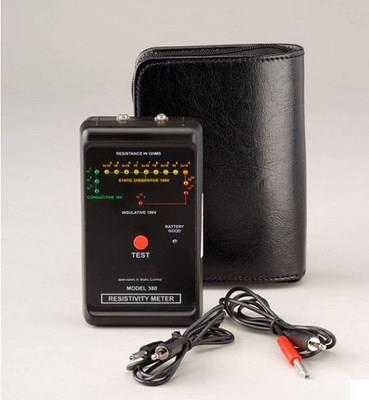
Calibration cycle:
The ACL-380 surface impedance meter should be calibrated every twelve months.
Using a decimal resistance box, connect the standard measuring resistor across the two parallel electrodes of the ACL-380 to verify that the impedance values displayed are correct.
Parameters:
Power: 9 volt PP3 alkaline battery
Measuring voltage: 9 volts
Temperature range: Operating temperature 5 degrees Celsius to 49 degrees Celsius
Storage temperature: -15 degrees Celsius to 60 degrees Celsius
Relative humidity: 0% to 90% (non-condensing state)
Measurement: 10 orders of magnitude
Transition point: 1/2 logarithm (3.16 × 10n)
Transition point accuracy: ±1/2 level
Accuracy: ±10%
Repeatability: ±5%
Weight: 170 grams
Size: 130 × 70 × 25 (mm units)
ACL-380 surface impedance meter calibration steps
The ACL-380 uses a 1% ultra-thin film resistor and a high-speed amplifier circuit. The calibration procedure is based on the linear circuit technology of the product.
The conversion point of the impedance value is 1/2 level logarithm, 3.16×10n, and the linear value of the conversion point is ±10% of the mean value per unit of the measurement.
Measuring instrument: decimal resistance box, test electrode
The resistance of the resistor box needs to be 1 × 10³ ohms to 999 × 106 mega ohms or 109. When measuring more than 109 resistance, CAD technology (cad Generated techniques) is used, because it is difficult to verify that the impedance value is greater than 999×106 by using 9 volts. resistance.
Connect the two electrodes of the resistance box to the two parallel electrodes of the ACL-380, adjust the resistance to 1K position, the light-emitting diode (LED) of the table should be bright, and the calibration of other files and so on. When measuring the impedance conversion point When the switch is pressed, the impedance value of the impedance bridge is continuously adjusted, and the impedance value when the next LED light is always on (the value at this time is the converted impedance value) is observed.