


Do you understand the internal structure of the ion fan?
In the static elimination industry, it is very familiar to the ion fan, but the outsiders are still very strange to it. What is the internal structure of the ion fan? What material is used?
Six important components of the ion fan: high-voltage transformer, discharge needle holder, control panel, micro-fan, metal casing, front and rear windshield; other auxiliary components include metal brackets, reinforced nuts, front and rear labels.
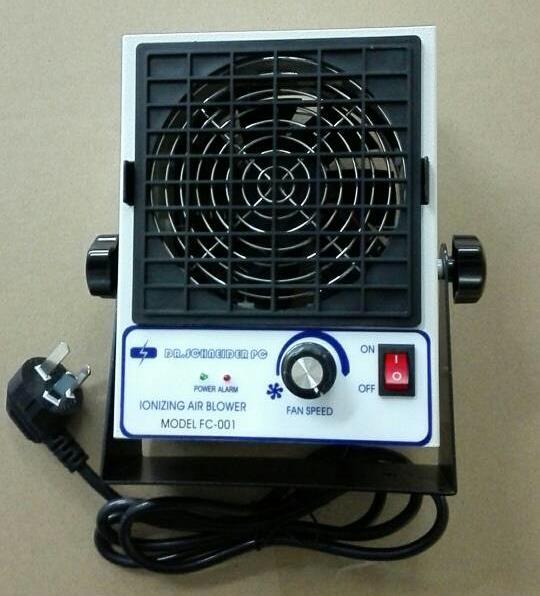

Through the above configuration, the working principle of the ion wind can be roughly seen: the low voltage power supply is connected, and then the current voltage is raised to 1000 volts or more via a small transformer. At this time, the discharge needle separates the air into a positively and negatively charged ion gas stream, and finally passes through the micro The fan blows out the ion current to the surface of the object, neutralizes the electrostatic charge on the surface of the object, and finally eliminates the static electricity on the surface of the object.
During the action of the ion fan, the discharge needle and the transformer play a very important role, which largely determines whether the device can release ions and release ions. If the transformer is unable to raise the voltage to the desired height, the air will not be ionized, and if the discharge needle ages or is contaminated, it will also affect the amount of ions released.
Generally, the ion fan on the market is forbidden to be disassembled by non-professionals. The front page cannot guarantee safety. It is not easy to assemble after dismantling. The KESD ion fan does not need to worry about these two problems at all. It can be disassembled by itself. When the front wind window is opened, it will automatically power off and the safety is extremely high. The discharge needle can also be removed and cleaned at will. Therefore, it is necessary to master the structure of the ion fan.