


Principle and use of static eliminator
A static eliminator can also be called a static elimination device, and its principle is as follows. It is composed of a high-voltage power generator and a discharge electrode (usually made of ion needles). The air is ionized into a large number of positive and negative ions through high-voltage corona discharge, and then a large number of positive and negative ions are blown to the surface of the object to neutralize static electricity, or Directly put the static eliminator close to the surface of the object to neutralize static electricity.

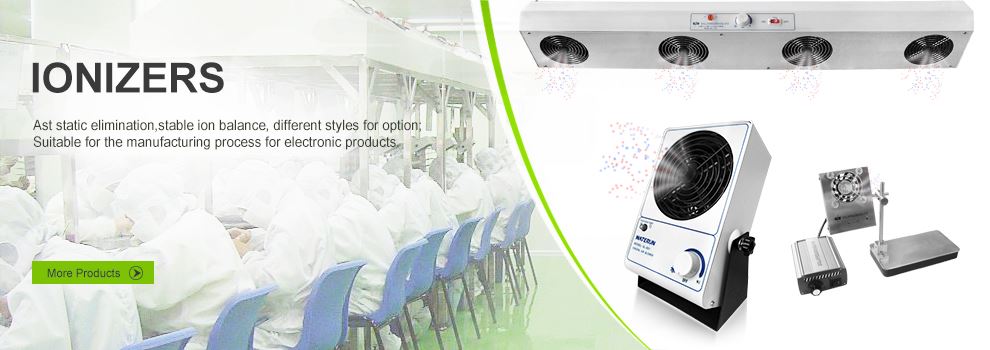

The static eliminator can also be called a static elimination device, and its principle is as follows. It is composed of a high-voltage power generator and a discharge electrode (usually made of ion needles). The air is ionized into a large number of positive and negative ions through high-voltage corona discharge, and then a large number of positive and negative ions are blown to the surface of the object to neutralize static electricity, or Directly put the static eliminator close to the surface of the object to neutralize static electricity.
The main types of static eliminators are as follows:
AC corona new product
AC high-voltage generator raises the 220V input voltage to above 4KV. The discharge electrode alternates with positive voltage and negative voltage at a frequency of 5 Hz. A strong electric field is generated between the discharge electrode and the ground electrode. Air molecules are ionized, and the tip of the discharge electrode alternately generates positive and negative ions. When the surface of a charged object is at a positive potential, the negative ions will neutralize it. Conversely, if the surface is at a negative potential, the positive ions will neutralize it. AC corona products must be grounded to work normally, but some positive and negative ions will be guided to the ground due to grounding, but the structure is simple and the positive and negative ions have a good balance. Principle of static eliminator-Yanlong Furniture-Yanlong Furniture
DC corona products
The DC high voltage generator raises the 220V input voltage and outputs positive and negative voltages respectively. A strong electric field is generated between the positive and negative discharge electrodes. Air molecules are ionized. The positive discharge electrode tip produces positive ions, and the negative discharge electrode tip produces negative ions. Negative ions are generated at the same time to neutralize the static electricity on the surface of the object. When the surface of the charged object has a positive potential, the negative ions will neutralize it. On the contrary, if it is a negative potential, the positive ions will neutralize it. DC corona products can generate positive and negative ions without being grounded. The positive and negative ions acting on the surface of the object are sufficient, and the speed of neutralizing static electricity is very fast. Principle of static eliminator-Yanlong Furniture-Yanlong Furniture
Pulse DC Corona Products
Pulse DC high voltage generator raises 220V input voltage and outputs positive voltage and negative voltage in turn in a cycle of 4-6 seconds to act on the discharge electrode, thereby alternately generating positive and negative ions. When the surface of a charged object is at a positive potential, the negative ions will neutralize it. Conversely, if the surface is at a negative potential, the positive ions will neutralize it. Since the pulse direct current positive and negative ions and the switching cycle are 200-300 times longer than the power frequency alternating current static eliminator, there will be no self-neutralization of the positive and negative ions, and at the same time, the positive and negative ions do not need to be grounded, and can be adjusted according to the distance of the static elimination object The conversion period, the distance is long, the conversion period can be long, and the time can be short when the distance is close. The pulse DC static eliminator can reach the working distance of positive and negative ions without a fan.