


Testing method for antistatic performance of clean work clothes

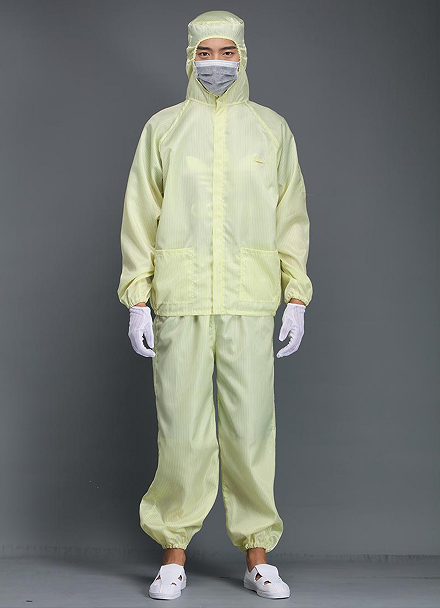


Antistatic performance is an important characteristic of clean clothes, especially in industries such as microelectronics, where the antistatic performance of clothing is more stringent. So how can we effectively test the antistatic performance of clean work clothes?
(1) Frictional charging voltage method
The testing principle of this method is to make the sample and the standard cloth rub against each other under certain tension conditions, and use the highest voltage and average voltage generated at this time to evaluate the frictional charging relationship between the wearer and the outerwear.
The method is to use a sample (4 pieces, 2 warp, 2 weft, size 4cm×8cm) to clamp the sample clamp on a drum (outer diameter 150±1mm, width 60±1mm), and rub the drum with the standard cloth (nylon or polypropylene) at a speed of 400rpm to test the maximum value (V) of the sample charge voltage within 1min.
(2) Charge surface density method
The sample is rubbed with the nylon standard cloth in a specific way under specified conditions.
The test method can be based on the national standard GB/T12703-91 "Test Method for Electrostatics of Textiles". Since the fabric used for clean clothes is polyester filament fabric with woven conductive threads, only the friction charging voltage (B method), charge surface density (C method) and friction charging of work clothes (E method) in this standard are suitable for the anti-static performance test of clean work clothes.