


I tell you how to test anti-static clothing for dust-free clothing


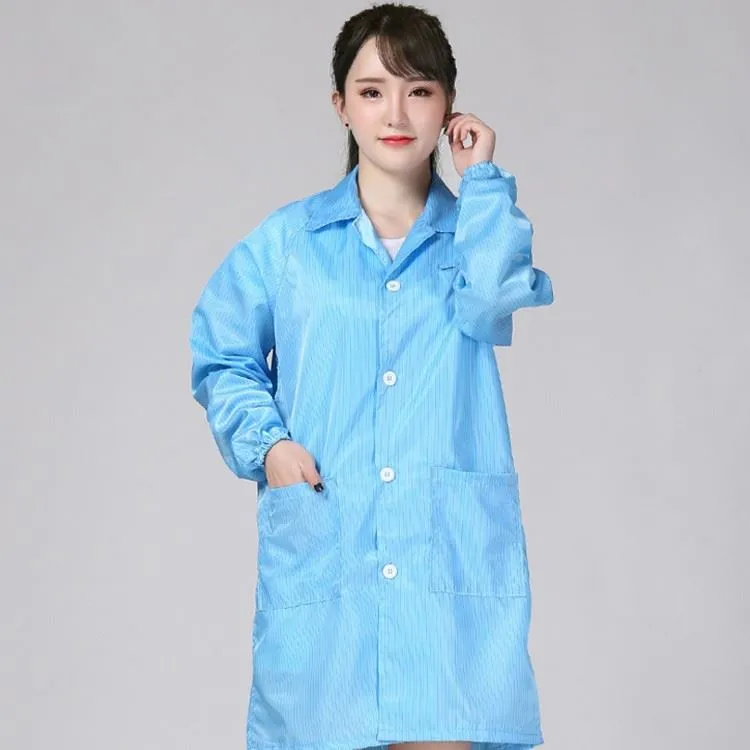

Since there is no testing standard for clean clothing, companies can select testing items in actual conditions during testing. Specific item recommendations are given below.
1. Clean function:
The basic requirements of the clean function are high filtration and low dust generation. The evaluation of clean function needs starts from two aspects: dust-free and dust-filtering. Dust-free means that the clothing itself does not generate dust, and dust-filtering means that the clean clothes isolate human particles from spreading out.
No dust:
The dust-generating function evaluation of the dust-free clothing itself generally adopts the Helmke drum method, which is to put the work clothes in a closed stainless steel drum, and roll over and conflict according to a certain procedure. The air in the drum is sampled through a dust particle counter, and the sample is calculated per unit time. The number of particles (particle size ≥0.3μm) generated inside should be ≤500/min.
Dust filter:
The particle filter power test is to clamp the clean clothes on a fixed device, and extract air perpendicular to the sample through a vacuum pump, so that regular-sized particles pass through the sample under a certain concentration and pressure, and use a dust particle counter to measure the particles in the space at both ends of the sample. The number, calculated based on the results, should be ≥50% (particle diameter 0.5μm).
2. Anti-static function:
The anti-static function of clean clothes can be judged simply with a hand-held surface resistance meter. The principle is to calculate the resistance per unit area of the sample between the electrodes by applying a voltage on the ring electrodes. The essence is to test the area resistance of the fabric. According to the rules of GB/T 24249-2009 "Anti-static clean fabric": Qualified dust-free clothing should have a small resistance (1×10⁵~1×10¹¹ Ω/□ within a certain scale) and a stable resistance value.