


Ion generator use and monitoring
The most efficient way to neutralize assembly equipment and surfaces that generate electrostatic charge is to use an ionizer - a device that blows out an ionized air stream over the working area to neutralize any charge accumulated on the insulating material.
Due to the use of ionizers, manufacturers can accept the fact that some insulating materials appear in their EPA. Because the ion generation system continuously neutralizes any charge buildup that may occur above the insulator, they are a reasonable investment for any ESD plan.
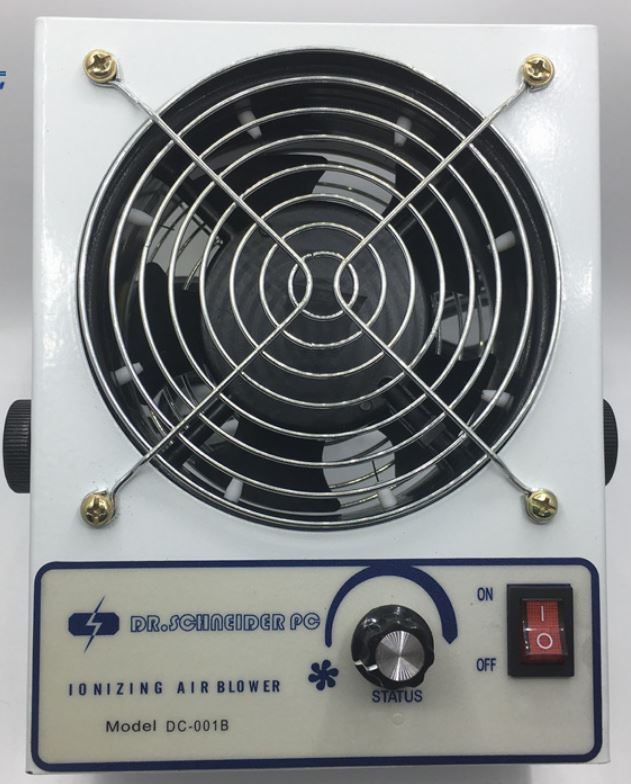
There are two basic forms of ion generating devices in standard electronic assemblies:
* Over-the-top equipment (in a single over-the-top unit with a range of fans)
There are also indoor ion generators, but now they are mainly used in the clean room environment.
The choice depends on the size of the area that needs to be protected. The desktop ionizer will cover a single working surface, while the overtop ionizer will cover two or three. Another advantage is that the ionizer also prevents dust from electrostatically attaching to the product, potentially degrading the appearance.
However, without proper testing and monitoring of the effectiveness of ESD equipment, no protection plan is perfect. State-of-the-art ESD control and ionizer experts report examples of manufacturers that use failed (and therefore useless) ESD devices without knowing their failure.

To prevent this, in addition to standard ESD equipment, ESD suppliers offer a variety of constant monitors that automatically alert if a performance is out of specification. The monitor can be used as a stand-alone unit or connected together in a network. There is also network software for automatic data collection that displays system performance for operators and workstations in real time.
The monitor simplifies ESD planning by eliminating many daily tasks, such as ensuring proper measurement of the wristband every day, balancing and proper maintenance of the ionizer, and no damage to the workbench grounding point.
In ESD protection, the time and money invested in the right equipment and improved safety procedures will be rewarded by an increase in the corresponding pass rate.