


The Role of Conductive Fibers in Anti-static Clothing
Anti-static garments are made from anti-static, dust-proof fabric (commonly known as "conductive silk"), which is woven using specialized polyester filament and high-performance permanent conductive fibers through a unique process. This fabric incorporates conductive fibers woven into the warp or weft directions. Specialized overlock sewing machinery is used during manufacturing to effectively minimize particle generation. Dust-free hook-and-loop fasteners prevent environmental contamination caused by lint shedding. Various styles are available to meet different cleanliness class requirements, and conductive fibers are used in the stitching to ensure electrical continuity across the garment; the cuffs and trouser hems feature a unique double-layer design, utilizing conductive or anti-static ribbed fabric for the inner layer to satisfy the demands of high-grade cleanroom environments.

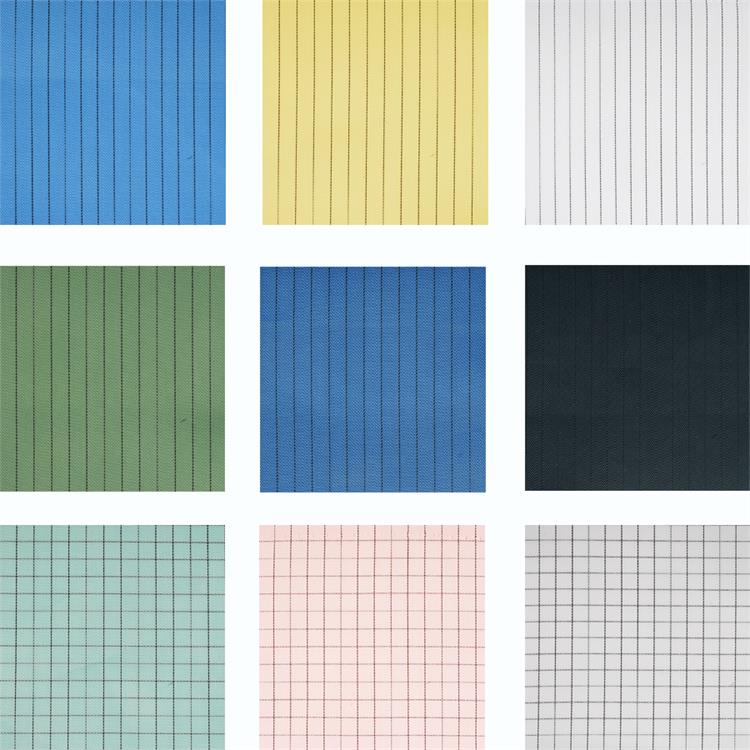
As anti-static requirements in industries such as electronics, semiconductors, and LCD manufacturing continue to rise, so does the demand for the conductive fibers used in anti-static clothing. Generally, fibers with a resistivity of less than 10⁷ Ω·cm are classified as conductive fibers. Conductive fibers used in anti-static clothing must possess appropriate fineness, length, strength, and flexibility; they should blend well with other standard fibers and be suitable for mixed spinning or interlacing. They must exhibit excellent resistance to friction, bending, oxidation, and corrosion without compromising the fabric's hand-feel or appearance, while offering superior and durable conductivity. Organic conductive fibers include standard textile fibers coated with metal or carbon, as well as fibers produced by blending or composite spinning conductive substances-such as carbon black, graphite, metals, or metal oxides-with standard polymers. Metal fibers offer excellent conductivity, heat resistance, and chemical corrosion resistance; however, for textile applications, they suffer from poor cohesion and spinning performance, and limit color options. Consequently, they are mostly used in carpets and industrial workwear fabrics, and are expensive to produce as fine-denier fibers. Carbon fibers also offer excellent conductivity, heat resistance, and chemical resistance, but their high modulus, lack of toughness, poor bending endurance, and lack of thermal shrinkage make them unsuitable for textile applications.