


Selection and testing methods of esd anti-static brushes
The anti-static esd toothbrush-type brushes sold on the market can be divided into three types: large, medium and small, which are suitable for cleaning various electronic components, PCB boards, etc., and can also be used to scrub PCB boards.
Paint brush-type brushes are divided into two types: round handle and straight handle, each of which has different sizes, which are suitable for cleaning various electronic components, PCB boards, etc.
Type brushes are also divided into three types: large, medium and small, which are suitable for cleaning various electronic components, PCB boards, etc., and can also be used to scrub PCB boards.
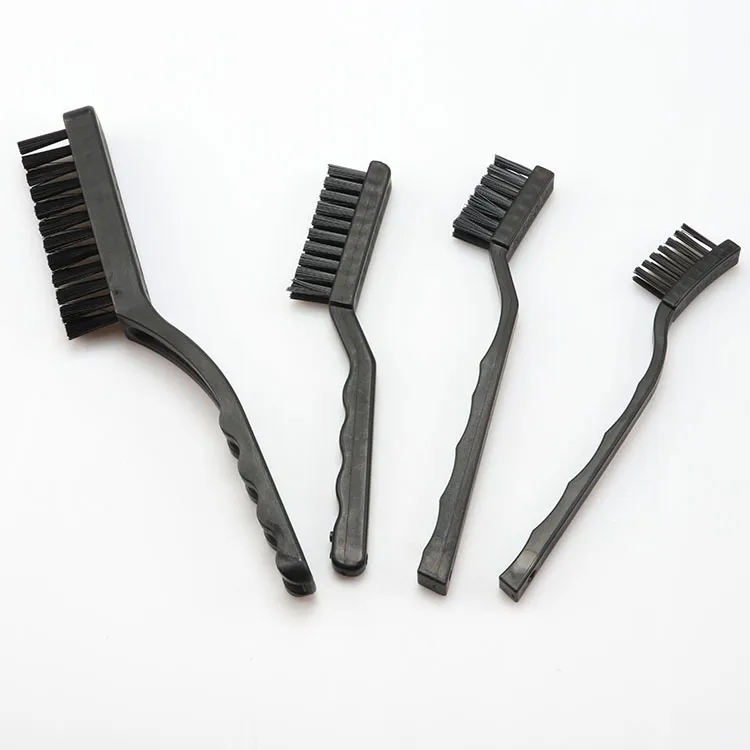


Special-shaped brushes are specially designed for certain processes, such as long aluminum alloy anti-static brushes made for plastic printing.
Purchase:
The choice of soft or hard bristles of anti-static brushes should be determined according to the requirements of the components and PCB boards to be cleaned. If you are afraid of scratches, choose a suitable soft-bristle brush, but the cleaning effect of hard-bristle brushes is superior.
Test method:
) Surface resistance of brush hair and brush handle:
Resistance test Point-to-point resistance and system resistance test Electrode structure size: Column electrode diameter 63 mm ± 3 mm: Electrode material is stainless steel or copper; Electrode contact end material is conductive rubber, hardness 60 ± 10 (Shore A grade), thickness 6mm ± 1mm, and its volume resistance is less than 500Ω: Electrode weight 2.25 kg? 2.5 kg.
Test voltage requirements are shown in Table 1.
When testing point-to-point resistance, the product (material) should be placed on an insulating table or placed in the actual use state. The surface resistance and volume resistance of the table are greater than 1x10^13Ω respectively, and its geometric perimeter dimensions are both greater than 10 cm of the material being tested. The distance between electrodes is 300 mm. When testing on the ground, the distance between electrodes is 900 mm to 1000 mm.
When testing system resistance, the actual use condition of the sample (ground) to be tested should be tested. During engineering testing, the electrode is greater than 10 cm from the edge of the material being tested.
Table 1 Test voltages for different resistance ranges:
2) Triboelectric voltage test:
Use a triboelectric machine to generate electricity through friction, and use a non-contact electrostatic voltmeter to test the triboelectric voltage. The friction electrode of the triboelectric machine is cylindrical, with a diameter of 50 mm to 60 mm, a weight of 1 kg, a volume resistance greater than 1x1O^13 ohms, and is wrapped with high-insulation nylon cloth (surface resistance not less than 1x1O^13 ohms) to increase the friction coefficient (see Figure 1). During the test, start the triboelectric machine to rub the friction electrode against the object to be tested, rub 20 times in one direction (time 20s) and stop, and use a non-contact electrostatic voltmeter to test the triboelectric track electrification voltage within 10s.